In the previous posts, we have discussed derivatives. If you have not seen that post, you can check it out here. In this post, we will discuss the important terms associated with options.
Before starting derivatives, it is important to understand the terms associated with it so we can make full use of them while developing our strategies. So, we will begin with understanding the important terms related to Options.
1. Spot Price
It is the price at which the underlying of the derivative is trading in the cash equity market. For example, if we are trading the derivative of SBI, then the underlying will be SBI stock, and its price in the cash equity market is called the spot price.
2. Call and Put Options
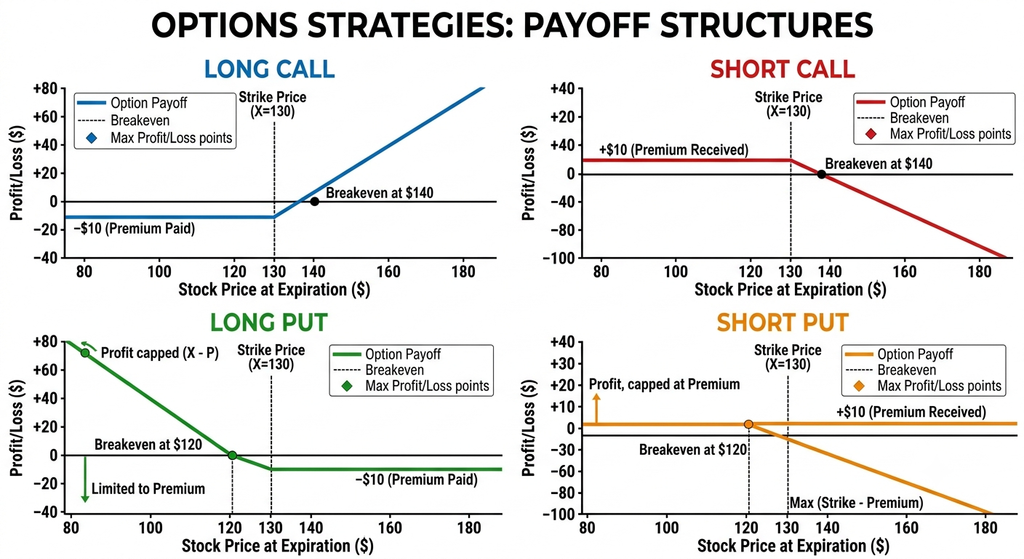
A call option is used when the person is bullish on the underlying. A put option is used when the person is bearish on the underlying. Although a call option can be shorted if the person is bearish on the underlying, and a put option can be shorted if the person is bullish on the underlying. Refer to the table below for better clarity on the Call and Put options. Using the short put or long call for a long position and vice versa depends on the strategy of the person. The trade offs for them are given in the table below.
| Position | Market View | Risk Profile |
|---|---|---|
| Long Call | Bullish | Limited loss, unlimited gain |
| Short Call | Bearish | Limited gain, unlimited loss |
| Long Put | Bearish | Limited loss, large gain (up to spot → 0) |
| Short Put | Bullish | Limited gain, large loss (if spot → 0) |
3. Intrinsic Value
This is the amount of money you would make if you exercised the option right this second.
- For a Call: It’s how much the stock price is above the strike price.
- For a Put: It’s how much the stock price is below the strike price.
- If an option is Out-of-the-Money (OTM), its intrinsic value is $0.
3. Extrinsic Value
This is the premium you pay for the possibility that the stock moves in your favor before expiration. It depends heavily on two factors:
- Time to Expiration: More time means more opportunity for a big price move, making the option more expensive. As expiration approaches, this value melts away (a process called Time Decay).
- Implied Volatility (IV): This measures how wildly the stock is expected to swing. High volatility means a higher chance of a massive price move, which jacks up the option’s price.
4. The Options “Greeks”
The Greeks are a set of risk measures that indicate how sensitive an option’s price is to changes in the underlying asset’s price. Think of them as the dashboard in your car, telling you how various forces are affecting your trade.
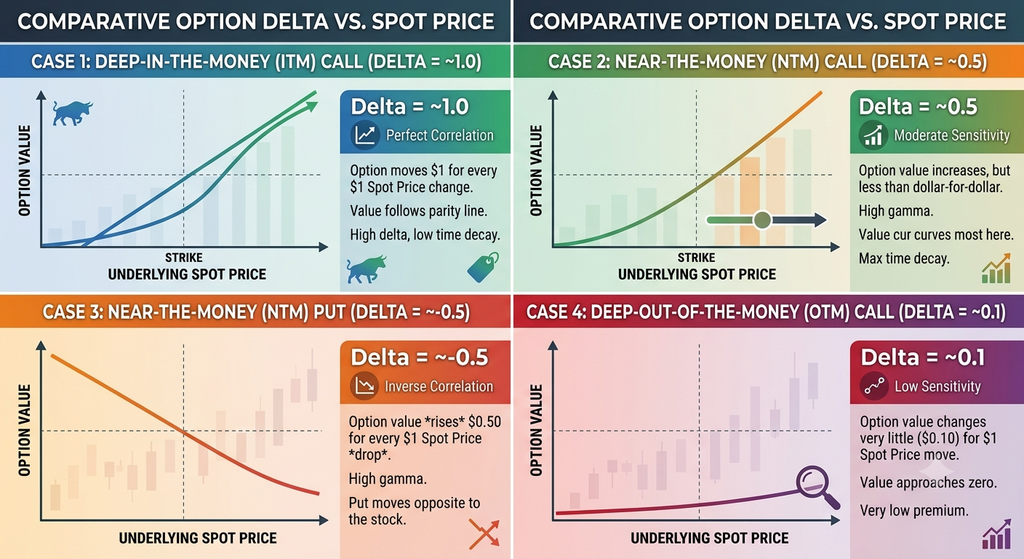
- Delta: The Speedometer. Measures how much the option’s price will change for every $1 move in the underlying stock. This measures the rate of change of options premium based on the directional movement of the underlying.
- Example: If a Call has a Delta of 0.60 and the stock goes up by $1, the option price will increase by $0.60. (Delta also roughly represents the percentage chance the option will expire in the money).
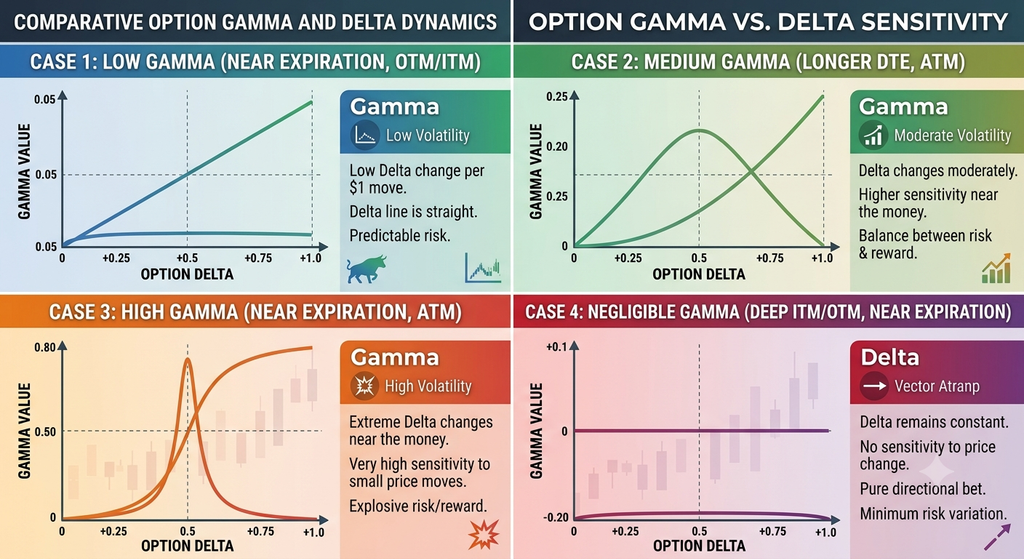
- Gamma: The Accelerator. Measures how fast the Delta changes for every $1 move in the stock. It is the rate of change of Delta itself. If Delta is speed, Gamma is acceleration. High Gamma means your Delta can swing wildly with small stock moves.
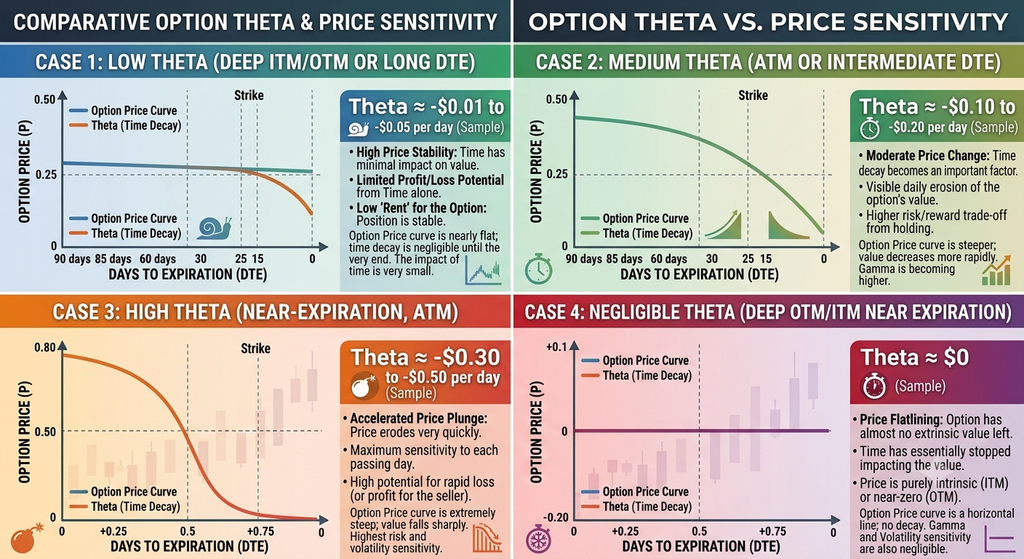
- Theta: The Clock. Measures how much the option’s price drops every single day just because time is passing (Time Decay). Theta is a negative number for options buyers because time is your enemy. It is the rate of change of premium based on change in volatility.
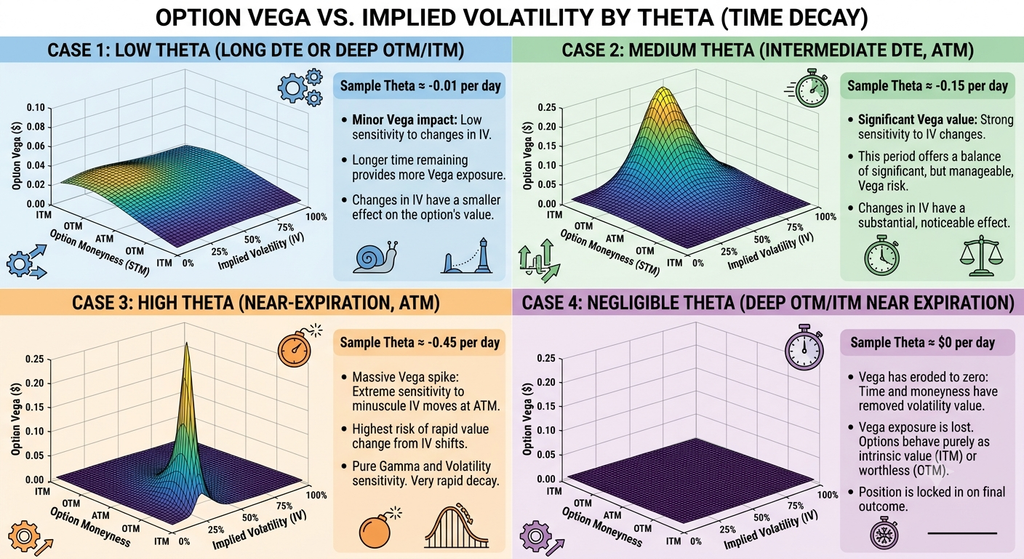
- Vega: The Weather. Measures the sensitivity of the option to changes in Implied Volatility. If Vega is 0.10, the option price will gain $0.10 for every 1% increase in the stock’s volatility. It measures the impact on premium based on time left to expiry.
5. Moneyness of Options
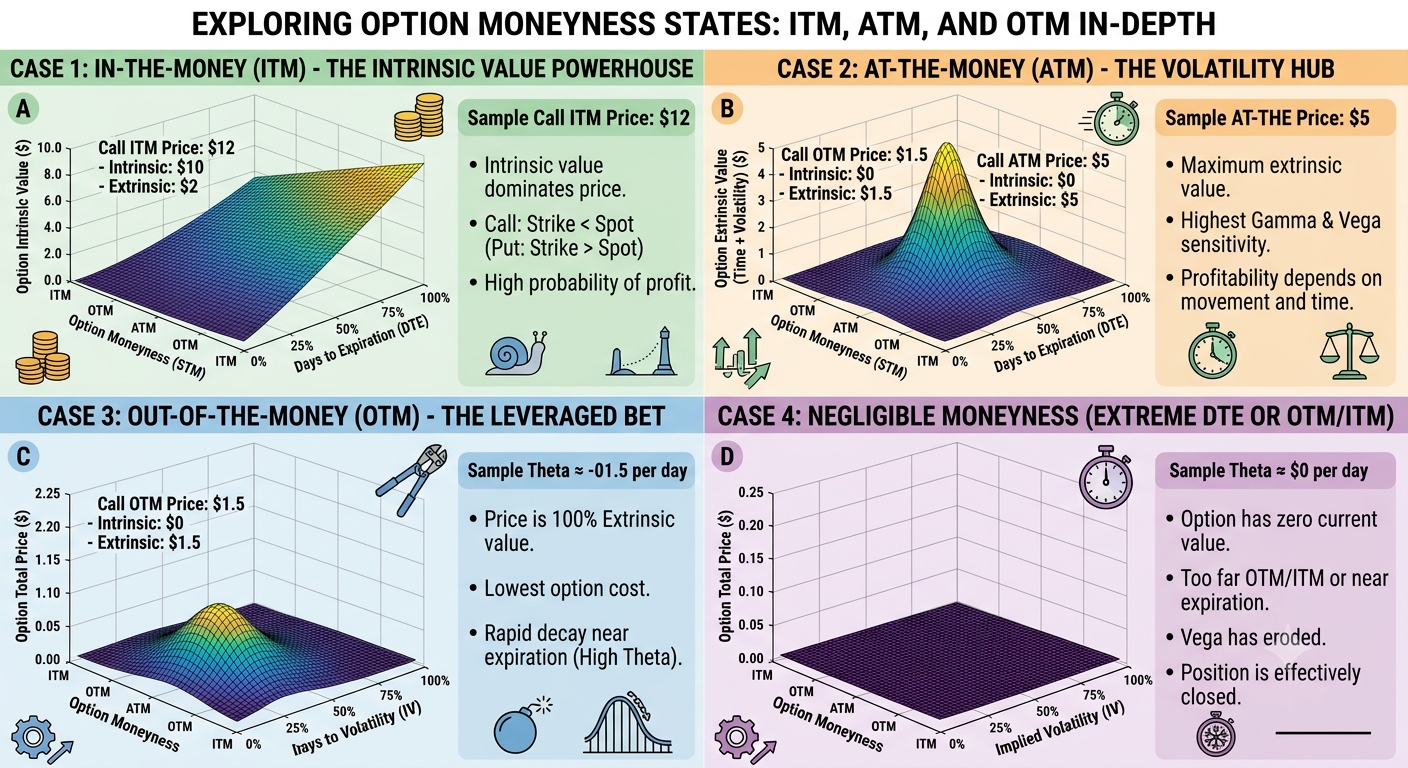
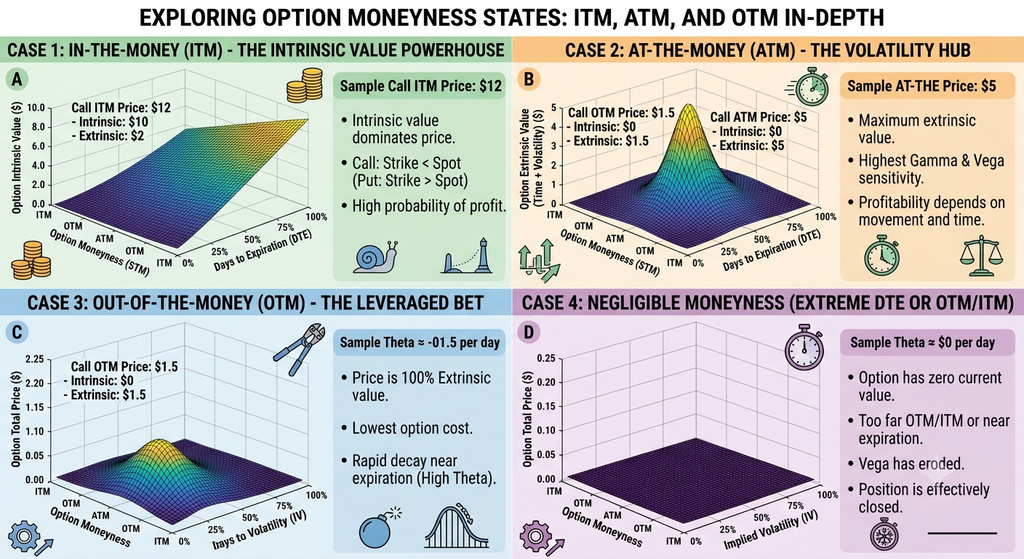
The moneyness of an option contract is a classification method wherein each option (strike) gets classified as either In the money (ITM), At the money (ATM), or Out of the money (OTM). This classification helps the trader to decide which strike to trade, given a particular circumstance in the market.
Classifications depend on which side of the spot price the option strike price falls toward.
If the option strike price is below the spot price, it falls under a different category.
If the option strike price is above the spot price, it falls under another category.
The three broad classifications are as follows:
- In the Money (ITM) – For the Call option, option strikes that are below the ATM strike are considered ITM, while for the Put option, option strikes which are higher than the ATM are considered ITM.
- At the Money (ATM) – It is the option strike which is closest to the Spot price.
- Out of the Money (OTM) – For a call option, option strikes that are higher than the ATM strike are considered OTM, and for the Put option, all the option strikes that are lower than the ATM are considered OTM.
6. Volatility.
Volatility is a statistical measure of the dispersion of returns for a given security or market index. It can be measured by the standard deviation or variance between returns from that same security or market index. Commonly, the higher the standard deviation, the higher the risk.
But there are several other ways of calculating the volatility of a financial security. I will elaborate in a different blog post.
This is all for this post. Don’t forget to follow my Facebook and Instagram pages for regular updates. Hope you learned something new from this post. See you all in the next post. Till then, keep learning.