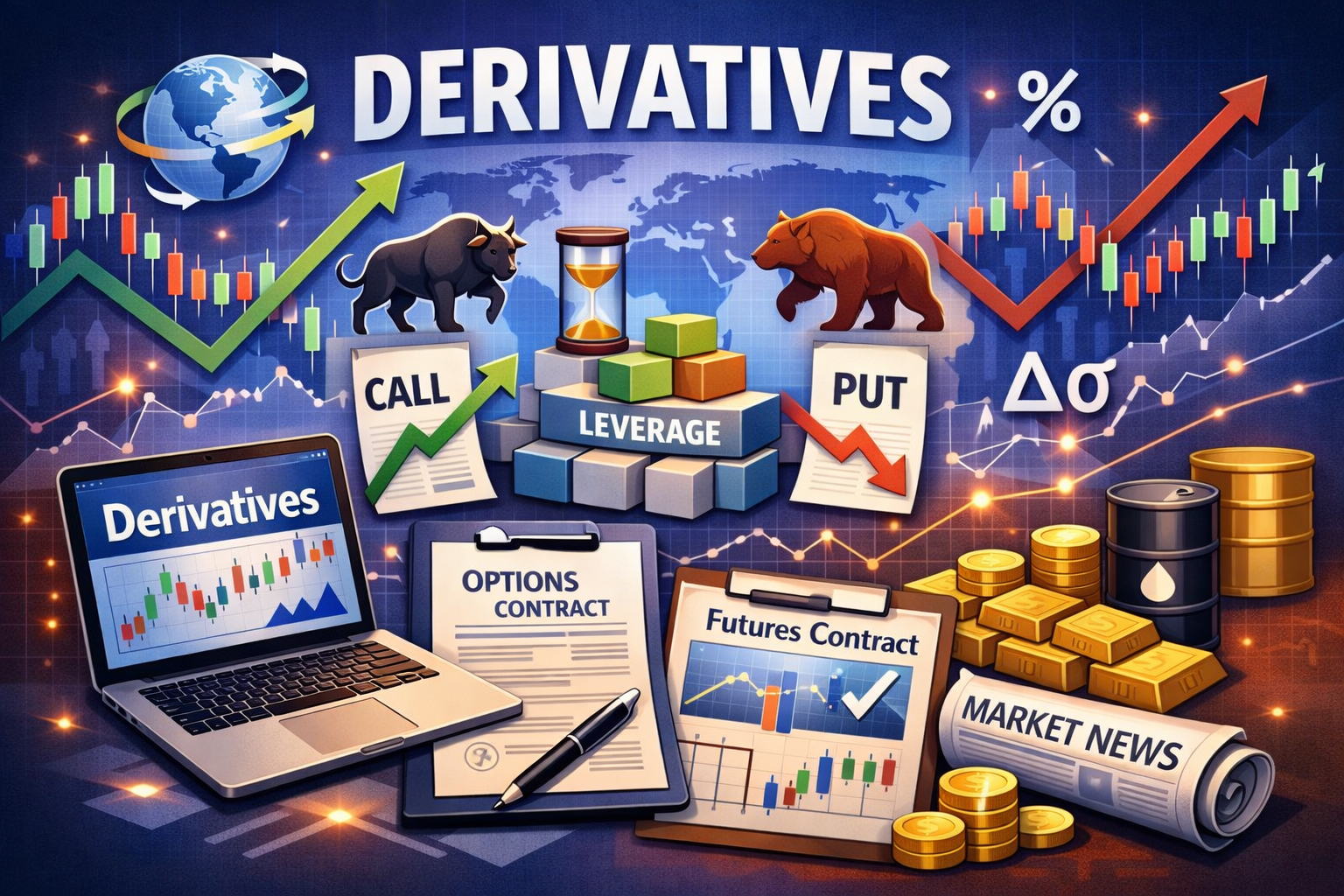
In the previous posts, we have discussed different types of Trading. If you have not seen that post, you can check it out here. In this post, we are going to understand a topic that is often viewed as unfavourable in financial markets in the Indian context. In this post, we will discuss Derivatives.
At its core, a derivative is a financial contract whose value is dependent upon—or derived from—an underlying asset. This underlying asset could be anything: stocks, bonds, commodities (like gold or oil), currencies, or even interest rates.
Think of it like a shadow. If the person (the underlying asset) moves, the shadow (the derivative) moves too.
Derivatives are primarily used for two reasons:
- Hedging (Risk Management): Protecting against unfavorable price movements (like a farmer locking in a price for their crops ahead of harvest).
- Speculation: Betting on the direction of price movements to make a profit.
The two most common types of derivatives retail investors encounter are Futures and Options. Let’s break them both down.
1. Futures: The Obligation
A Futures Contract is a binding agreement between two parties to buy or sell an asset at a predetermined price on a specific future date.
The defining characteristic of a futures contract is obligation. Both the buyer and the seller must fulfill the contract, no matter what happens to the market price in the meantime.
Key Terms Associated with Futures:
- Long Position (Buyer): The party that agrees to buy the asset in the future. They profit if the asset’s price goes up.
- Short Position (Seller): The party that agrees to sell the asset in the future. They profit if the asset’s price goes down.
- Expiry Date: The date by which the contract must be settled.
- Underlying Price: The current market price of the actual asset.
- Futures Price: The price agreed upon today for a future transaction.
- Margin: Because futures involve huge amounts of money, you don’t pay the full value upfront. Instead, you deposit a fraction of the total amount as a security deposit (called margin) to cover potential losses.
Everyday Example: Imagine you want to buy a house in 6 months, and the seller agrees today on a price of $300,000. In 6 months, even if the neighborhood property values skyrocket to $400,000 or crash to $200,000, you must buy, and they must sell at $300,000.
2. Options: The Choice
An Options Contract is similar to a future, but with one massive twist: it gives the buyer the right, but not the obligation, to buy or sell an asset at a set price within a specific timeframe.
Because the buyer gets a choice, they have to pay the seller a non-refundable upfront fee (like a down payment or insurance premium) to lock in this privilege.
The Two Types of Options:
- Call Option: Gives the buyer the right to buy an asset. You buy a Call if you think the price is going up.
- Put Option: Gives the buyer the right to sell an asset. You buy a Put if you think the price is going down.
Key Terms Associated with Options:
- Strike Price: The fixed, pre-agreed price at which the option holder can buy or sell the asset.
- Premium: The fee the buyer pays to the seller to purchase the option. This is the buyer’s maximum potential loss.
- Option Holder (Buyer): The person who pays the premium. They have all the rights and zero obligations.
- Option Writer (Seller): The person who collects the premium. They have the obligation to perform if the buyer decides to exercise their right.
- In-the-Money (ITM): When an option is profitable to exercise. E.g., A Call option with a strike price of $50 when the stock is at $60.
- Out-of-the-Money (OTM): When an option is not profitable to exercise. E.g., A Call option with a strike price of $50 when the stock is at $40.
Everyday Example: Think of an option like car insurance. You pay a monthly premium to the insurance company. If you get into an accident, you have the right to make a claim (exercise your option) to have them pay for it. If you don’t crash, you don’t use it, and the insurance company keeps your premium.
Futures vs. Options: A Quick Summary
| Feature | Futures | Options |
| Obligation | Both parties are obligated to execute. | Only the seller is obligated; the buyer has a choice. |
| Upfront Cost | Margin deposit (refundable balance). | Premium (non-refundable fee paid to seller). |
| Risk Profile | Unlimited risk for both buyer and seller. | Buyer’s risk is limited to the premium paid; Seller faces high/unlimited risk. |
To help clear things up, let’s look at a practical trading scenario for each so you can see exactly how the money moves.
Scenario 1: Trading a Future (The Obligation)
Imagine Apple (AAPL) stock is currently trading at $180. You believe the price is going to jump significantly over the next month, but you don’t want to tie up $180 of your cash right now to buy a full share.
- The Contract: You buy a 1-month AAPL Futures contract with a Futures Price of $180.
- The Margin: Instead of paying $180, you only have to put down a Margin of, say, $18 (10%) to hold the contract.
- The Expiry: One month passes, the contract expires, and AAPL is now trading at $210.
- The Outcome: Because you locked in the purchase price at $180, you are legally obligated to buy it at $180, and the seller is obligated to sell it to you. You instantly buy it for $180 and can sell it on the open market for $210, pocketing a $30 profit.
- The Twist: What if AAPL crashed to $150? You would still be forced to buy it at $180, resulting in a $30 loss (which wipes out your $18 margin and requires you to pay an extra $12).
Scenario 2: Trading an Option (The Choice)
Let’s use the same setup: Apple (AAPL) is at $180, and you think it’s going up. This time, you decide to use an option to limit your downside risk.
- The Contract: You buy a Call Option with a Strike Price of $180 expiring in one month.
- The Premium: Because you get the luxury of choice, you pay the seller a non-refundable Premium of $5. This is your total cost and maximum risk.
Now, let’s look at two different ways this could play out in a month:
Case A: Apple jumps to $210 (In-the-Money)
Because the market price ($210) is higher than your strike price ($180), your option is In-the-Money. You choose to exercise your right. You buy the stock at $180 and can immediately sell it for $210.
- Your Profit: $30 (market gain) – $5 (premium paid) = $25 net profit.
Case B: Apple crashes to $150 (Out-of-the-Money)
Because the market price ($150) is lower than your strike price ($180), it makes no sense to use your option to buy it at $180. The option is Out-of-the-Money.
- Your Outcome: You simply walk away and let the option expire worthless. You lose your $5 premium, but you don’t lose a single penny more, no matter how far the stock drops.
The Key Difference in Action
In the Futures scenario, you made $30 on the upside, but you risked losing a massive amount if the stock crashed.
In the Options scenario, your upside was slightly lower ($25 instead of $30 because you had to pay for the premium), but your downside was completely capped at $5.
In the next post, we will see how options are priced.
This is all for this post. Don’t forget to follow my Facebook and Instagram pages for regular updates. Hope you learned something new from this post. See you all in the next post. Till then, keep learning.