In the previous posts, we have discussed Portfolio Management Services. If you have not seen that post, you can check it out here. In this post, we are going to understand a topic that is often viewed as unfavourable in financial markets in the Indian context. In this post, we will discuss trading and its types.
So let’s start by understanding what trading is, or more specifically, what trading means in financial markets.
What is Trading?
At its core, trading in financial markets is the act of buying and selling financial assets with the goal of generating a profit from price fluctuations.
Unlike long-term investing—where you buy an asset (like a stock) and hold onto it for years to build wealth slowly—trading is generally more short-term. Traders use price movements to make money over days, hours, or even minutes.
How Trading Works: The Two Directions
In financial markets, you aren’t limited to making money only when prices go up. Traders operate in two directions:
- Going Long (Buying): You buy an asset at a lower price, expecting its value to rise, so you can sell it later for a profit. This is the traditional “buy low, sell high” model.
- Going Short (Short Selling): You borrow and sell an asset at a higher price, expecting its value to drop. If the price falls, you buy it back at the lower price, return the borrowed asset, and pocket the difference. This is “sell high, buy low.”
What Can You Trade?
Financial markets are massive and diverse. The most common asset classes include:
| Asset Class | What It Is | Example |
| Stocks | Shares of ownership in public companies. | Apple (AAPL), Tesla (TSLA) |
| Forex (Foreign Exchange) | Trading global currencies against each other. | EUR/USD (Euro vs. US Dollar) |
| Commodities | Raw materials or primary agricultural products. | Gold, Crude Oil, Coffee |
| Cryptocurrencies | Digital or virtual currencies using blockchain. | Bitcoin (BTC), Ethereum (ETH) |
| Indices | Baskets of stocks representing a specific market sector. | S&P 500, Nasdaq 100 |
The Golden Rule of Trading: Every trade involves risk. Successful trading isn’t about avoiding risk altogether; it’s about using strict risk management (like using “stop-loss” orders to cap your losses automatically) to ensure your winning trades outpace your losing ones over time.
Types of Trading
We can categorize trading through three distinct lenses: the clock (Time Horizon), the playbook (Strategy), and your comfort with uncertainty (Risk Tolerance).
1. Based on Time Horizon
This is defined by the duration between opening a trade and closing it out.
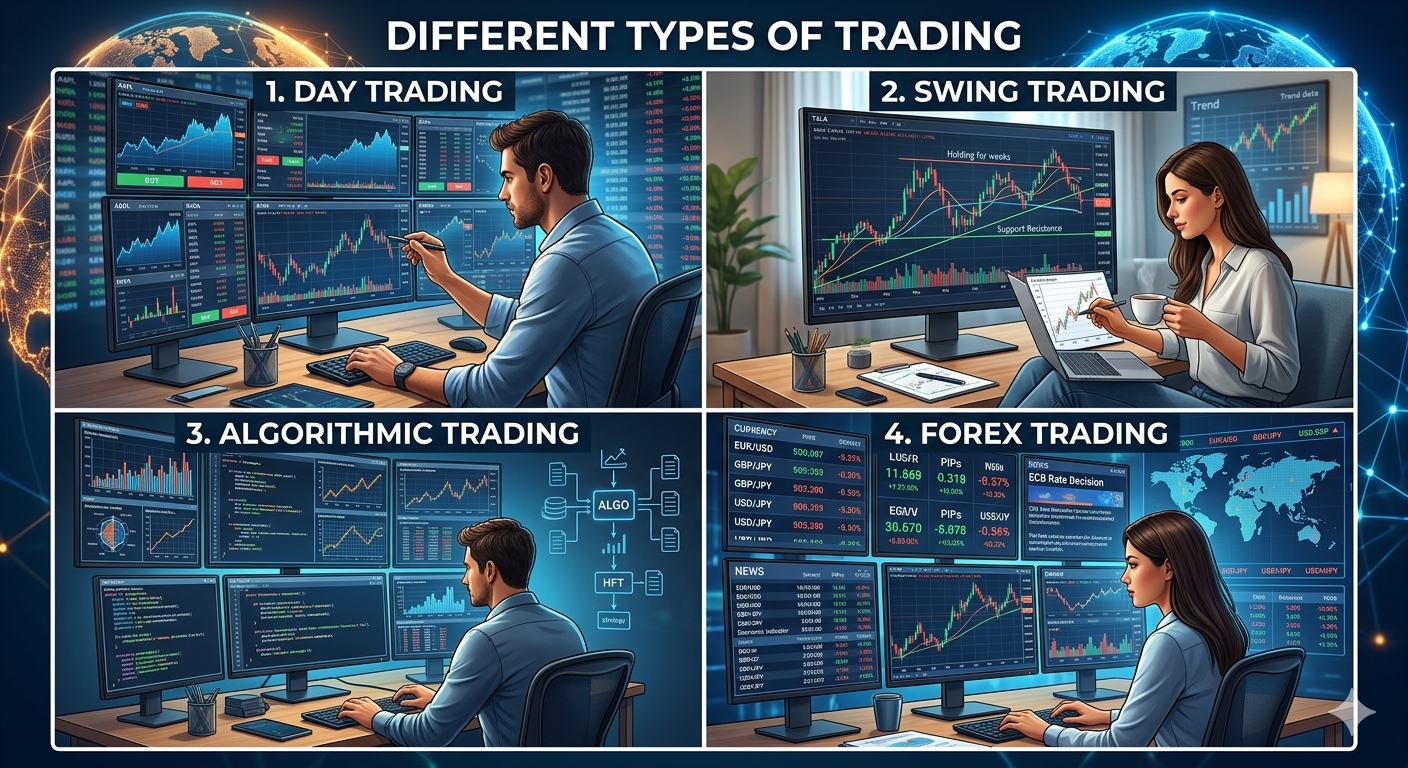
- Scalping (Seconds to Minutes): The shortest time horizon. Traders enter and exit positions almost instantly to exploit tiny price inefficiencies. Scalping is the fastest-paced trading style. Scalpers buy and sell assets within seconds or minutes, aiming to pocket tiny profits from minor price fluctuations.
- The Goal: Take dozens or hundreds of small profits throughout the day that add up to a significant gain.
- The Catch: It requires intense focus, strict discipline, and high transaction volumes. One large loss can easily wipe out a day’s worth of small wins.
- Day Trading (Hours): Positions are opened and closed within the same trading session. Absolutely nothing is held overnight. Day traders do not hold any assets overnight to avoid the risk of unexpected news causing price drops while the market is closed.
- The Goal: Capitalize on intraday (daily) price trends, often driven by news events, earnings reports, or economic data.
- The Catch: It is a full-time job that requires constant monitoring of the markets during operating hours.
- Swing Trading (Days to Weeks): Positions are held long enough to capture a multi-day market move or “swing” in momentum. Swing traders hold positions for several days to a few weeks. They use technical analysis to identify a “swing” in momentum — catching the wave as a stock starts an upward trend and selling before it turns around.
- The Goal: Capture a larger chunk of a market move than day trading allows, without needing to watch the screen every second.
- The Catch: Since positions are held overnight and through weekends, swing traders are vulnerable to market gaps (when a price opens significantly higher or lower than it closed the previous day).
- Position Trading (Months to Years): The longest time horizon, where short-term volatility is completely ignored in favor of macroscopic market shifts. Position trading is the closest style to traditional investing. Position traders look at long-term macroeconomic trends and foundational company health (fundamental analysis) to hold assets for months or even years.
- The Goal: Ride a massive, long-term market trend and ignore short-term market noise or daily price drops.
- The Catch: It requires high patience and capital lock-up, as money is tied up in long-term positions.
Trading vs. Investing: While position trading looks like investing, the mindset is different. Traders generally enter a position with a strict exit plan based on specific price targets or risk thresholds. Investors usually buy to own a piece of a business or asset for its fundamental growth over time.
2. Based on Strategy
This is defined by how a trader decides to enter a trade and the rules they follow.
- Momentum/Trend Trading: The strategy of “buying high and selling higher.” Traders identify a strong upward or downward price trend and ride it until signs of reversal appear.
- Mean Reversion: Based on the mathematical concept that asset prices eventually return to their historical average. Traders buy assets that are “oversold” or sell assets that are “overbought.”
- Breakout Trading: Traders watch for an asset’s price to break through a historically established ceiling (resistance) or floor (support), anticipating a massive surge in volume and price movement in that direction.
- Arbitrage: The simultaneous purchase and sale of the same asset in different markets to exploit small price differences between them (e.g., buying a stock on a US exchange and selling it instantly on a European exchange for a fraction of a cent more).
- Event-Driven/News Trading: A strategy centered around catalyst events. Traders capitalize on sharp price moves triggered by corporate earnings, economic reports, or geopolitical news.
3. Based on Risk Tolerance
This is defined by a trader’s psychological and financial capacity to handle capital losses and market volatility.
- High Risk Tolerance (Aggressive):
- Characteristics: Involves highly volatile assets, high leverage (borrowing money to multiply position sizes), and tight timeframes.
- Examples: Scalping or trading high-risk instruments like Options, Crypto, and Forex. A minor mistake or bad data feed can result in rapid, heavy losses.
- Medium Risk Tolerance (Moderate):
- Characteristics: Focuses on balanced risk-to-reward ratios. Positions are often diversified, and stop-loss rules are rigidly enforced to limit potential downsides.
- Examples: Swing Trading large-cap stocks or blue-chip commodities. Capital is exposed to overnight market gaps, but risk is heavily managed.
- Low Risk Tolerance (Conservative):
- Characteristics: Prioritizes capital preservation over explosive gains. Traders look for slow-moving, stable trends and rely heavily on fundamental data.
- Examples: Position Trading, index funds (ETFs), or stable dividend stocks. The risk of sudden catastrophic loss is low, but the potential for rapid wealth accumulation is also limited.
The Golden Rule of Risk: Your strategy and time horizon must align with your risk tolerance. For example, trying to swing trade highly volatile cryptocurrencies (High Risk Strategy) while being anxious about a 2% drop in your portfolio (Low Risk Tolerance) is a recipe for emotional, losing trades.
Major Types of Trading
To summarise all types of trading, refer to the table below:
| Type of Trading | Holding Period | Key Features | Best For |
|---|---|---|---|
| Day Trading | Same day | Buy/sell within hours; avoids overnight risk | Traders who want fast-paced action |
| Swing Trading | Days–weeks | Capture medium-term trends | Part-time traders balancing jobs |
| Position Trading | Months–years | Long-term trend following; less frequent trades | Investors with patience and capital |
| Scalping | Seconds–minutes | Very small price moves; high frequency | Traders with fast execution setups |
| Algorithmic Trading | Automated | Uses coded rules; removes emotion | Tech-savvy traders with coding skills |
| Arbitrage Trading | Instant | Exploits price differences across markets | Professionals spotting inefficiencies |
| High-Frequency Trading (HFT) | Milliseconds | Thousands of trades per second | Institutions with advanced infrastructure |
| Fundamental Trading | Weeks–years | Based on earnings, macro data | Investors focused on company value |
| Technical Trading | Any | Relies on charts, indicators | Traders who trust price action |
| Copy/Social Trading | Variable | Mirror other traders’ moves; community-driven | Beginners learning from experts |
| Prop Trading | Variable | Firm trades with its own capital | Professional traders in firms |
| OTC Trading | Variable | Direct deals outside exchanges | Niche or illiquid assets (e.g., bonds) InvestinGoal |
Choosing the Right Style
- Lifestyle fit:
- Full-time professionals often prefer swing trading or algorithmic systems.
- Those who dislike overnight risk lean toward day trading.
- Risk tolerance:
- Scalping/HFT → high stress, requires precision.
- Position trading → lower stress, but capital tied up longer.
- Skill set:
- Technical trading → chart analysis.
- Fundamental trading → financial statement analysis.
- Algorithmic trading → coding and system design.
- Resources:
- Scalping/HFT needs fast computers and low-latency brokers.
- Position trading needs patience and capital reserves.
Risks & Limitations
- Day trading/scalping: High transaction costs, emotional stress, risk of whipsaws.
- Swing/position trading: Exposure to overnight news shocks.
- Algorithmic/HFT: Requires infrastructure; vulnerable to sudden market regime changes.
- Copy trading: Dependent on the lead trader’s skill; risk of blindly following.
- Arbitrage: Opportunities vanish quickly; requires large capital.
This is all for this post. Hope you learned something new. Don’t forget to follow my Facebook and Instagram pages for regular updates. See you all in the next post. Till then, keep learning.