Till now, we have discussed personal finance topics. If you have not seen those posts, you can find them here. In this post, we are going to discuss something that is more fundamental to money and which helps us to attract money.
If you have read my previous articles, you would know that money is a store of value used in transactions. If you are aware and have read my previous articles, you would know that the money used nowadays is fiat money, which is essentially government debt.
So, what is value?
Value can mean different things depending on the context. In philosophy, value relates to ethics and what people consider good or desirable. In math, it’s simply the numerical quantity assigned to a variable.
In the field of Investing value helps in determining if a stock is undervalued or overvalued. In Corporate Finance, value guides in mergers, acquisitions, and capital allocation. In personal finance, value shapes decisions about saving, spending, and asset purchases. In policy making, economic value influences GDP measurement and taxation.
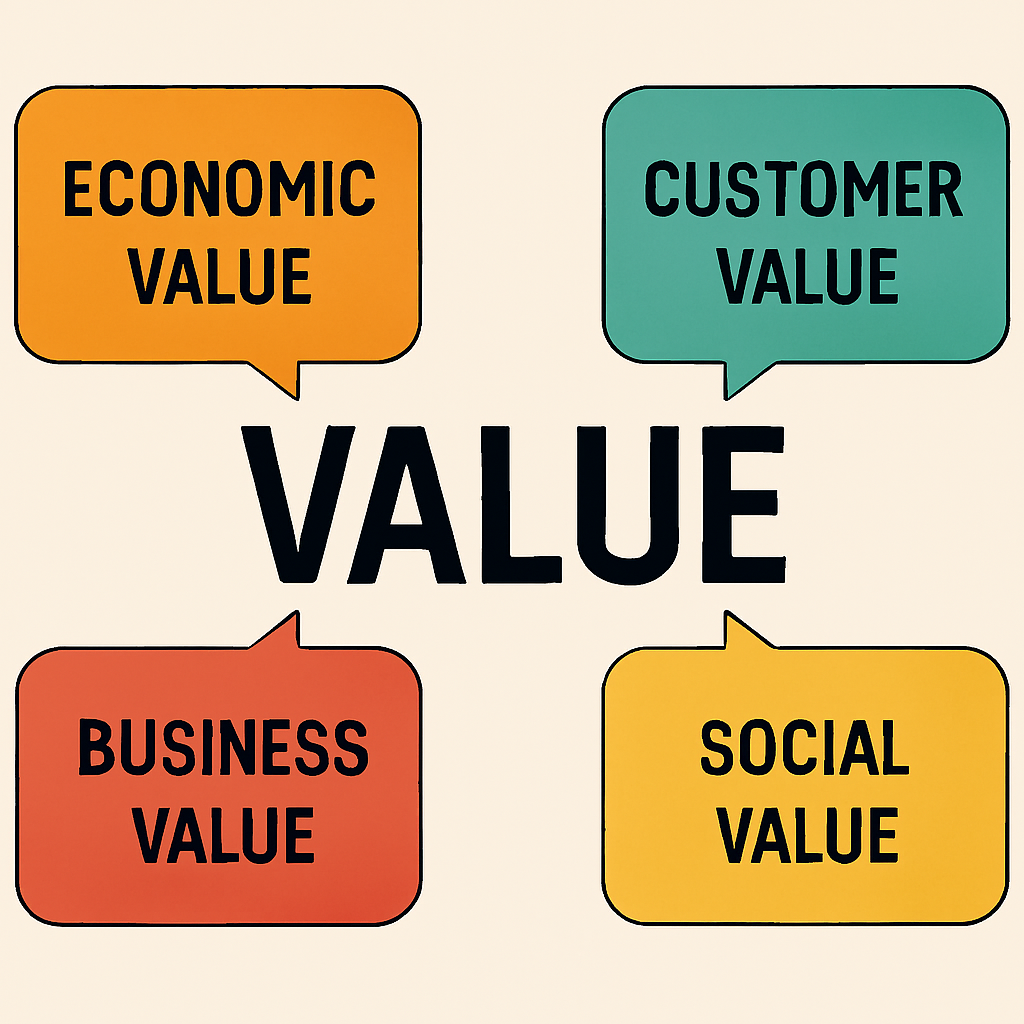
Refer to the table for the different types of value terms used in investing and finance.
| Economic value | It is the benefit derived from owning or using an asset, often measured by its contribution to GDP or utility |
| Market Value | It is the price at which an asset can be bought or sold in the open market |
| Fair value | It is an estimate of an asset’s worth based on objective models, often used in accounting and investing |
| Intrinsic value | It is the perceived or calculated true worth of an asset, independent of market fluctuations |
| Shareholder Value | It is the worth delivered to equity holders, often measured by stock price appreciation and dividends |
| Firm/ Enterprise value | It is the total value of a company, including equity and debt |
| Book value | It is the accounting value of a company’s assets minus its liabilities |
| Use value | It is the utility or satisfaction derived from consuming a product or service |
| Exchange value | It is the amount of money or goods an item can be traded for |
The table links how value translates into price.
| Aspect | value | price |
| Definition | monetary worth, intrinsic or perceived | amount paid in a transaction |
| basis | utility, fundamentals, market perception | supply and demand at a given time |
| stability | can be long-term and fundamental | fluctuates frequently |
| example | a stock’s intrinsic value based on earnings | the current trading price on the exchange |
However, true value is hard to determine due to the following reasons:
Subjectivity: Intrinsic value depends on assumptions
Market Volatility: Prices may diverge significantly from true value
Perception Bias: Consumer value is often influenced by branding or trends.
In finance, value is the measure of worth – whether money, assets, or companies. Price is what you pay, value is what you get.
In our context, business, value often refers to the benefits a product or service provides to customers. It refers to the worth of something, whether in terms of money, usefulness, importance, or personal meaning.
For example, suppose you have created something that a large group of people want, then they will be willing to give you money for your creation. But if you create something that is not valued by people, then people won’t be willing to give you money for the same. This is why it is said that value is in the lens of the perceiver.
So to make a lot of money, you can create something that is desired by a large number of people, that is, the market for the product is large, or create something valuable in the eyes of people who have a lot of money. And if you create something that is not valued by people, then it might give you satisfaction, but it won’t generate money.
How to create Value?
To create value and earn money, one has to first find the market for it, more precisely Total Addressable Market, also known as TAM. If the TAM is sizeable, then it makes sense to enter into it, or if the product is higher up in the value chain, it makes sense to enter the market.
Create products/ services that solve problems better than existing options. Reduce costs or improve processes to deliver more with less. Build loyalty by offering a superior experience or quality. Strong reputation adds intangible value beyond financials.
Businesses that employ people generate social and economic value. Long-term value comes from balancing profit with environmental and social responsibility. Education and innovation spread value across generations. The table shows the inputs provided and the value created.
| Inputs | Outputs (Value Created) |
| Capital | Wealth, returns, liquidity |
| Time | compounded growth, expertise |
| Skills | higher income, innovation |
| Relationships | trust, opportunities, networks |
| Ideas | products, services, intellectual property |
Selling Value
Selling value means convincing others to pay for the benefits you create, not just the product or service itself. It’s about showing why what you offer is worth more than the cost and how it solves a real problem better than alternatives. Try out these hacks to better sell your product.
Focus on outcomes, not features – don’t just list what your product/ services do, show what it achieves for the buyer (saves time, reduces cost, increases revenue, improves health)
Quantify the benefit – Translate value into numbers: ROI, cost savings, efficiency gains, or emotional benefits like peace of mind.
Differentiate clearly – highlight why your solution is unique compared to competitors.
Build Trust – Value is only believable if the buyer trusts you – credibility, testimonials, and transparency matter.
Tailor to the buyer’s priorities – A CFO cares about cost savings, while a CEO may care about growth. Match your pitch to their lens.
| Selling Price | Selling Value |
| Focus on cost | Focus on outcomes |
| Competes on discounts | long-term relationship |
| The buyer asks how much? | The buyer asks what I will gain |
Steps to Sell Value Effectively:
Follow the following steps to sell value effectively.
Identify pain points – What problem does the buyer face?
Show transformation – How your solution changes their situation
Use Proof – Case Studies, testimonials, data
Frame ROI – For every unit you spend, how many units do you gain
Close with confidence – Reinforce that the buyer is investing, not spending
Selling value is about positioning yourself as a solution provider rather than a cost center. You are not selling a product – you are selling outcomes, growth, and peace of mind.
Value chain
A value chain is a structured way of looking at how value is created step by step in a business or investment process. It maps all the activities—from raw inputs to final delivery—that add worth to a product or service. Creating a value chain means identifying these activities, organizing them logically, and optimizing them so each stage contributes to overall value.
Define the scope – decide whether you are mapping a company, a product line, or even your personal investment workflow
Identify primary activities –inbound logistics, operations, outbound logistics, marketing and sales, services
Identify support activities – firm infrastructure, human resources, technology development, procurement
Map the Flow – draw a chain diagram showing how each activity connects. highlight where value is added (cost reduction, quality improvement, differentiation)
Analyze the value creation – which steps add the most value? Which steps add cost but little differentiation?
Optimize – Streamline weak links (automation, outsourcing, better suppliers), strengthen strong links (branding, customer service, innovation)
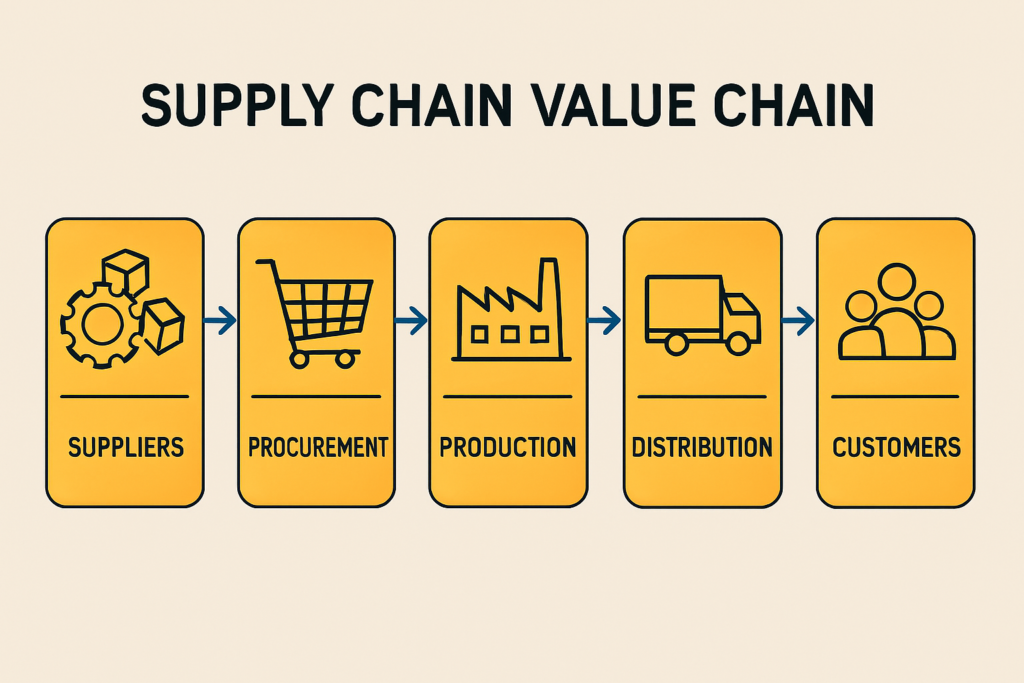
Value chain gives clarity as to where value is added or lost, a strategy to focus resources on high-value activities, a competitive edge to differentiate from rivals by excelling in unique links, and scalability to replicate strong chains across projects or businesses.
A value chain is a map of how value is created and delivered. To build one, list all activities, connect them logically, and optimize the strongest links while fixing weak ones.
So, to summarize this post, we discussed what value is, how it is created, how we sell value, and how to determine where to put our efforts to maximize value
This is all for this post. Don’t forget to follow my Facebook and Instagram Pages for regular updates. See you all in the next post. Till then, keep learning.