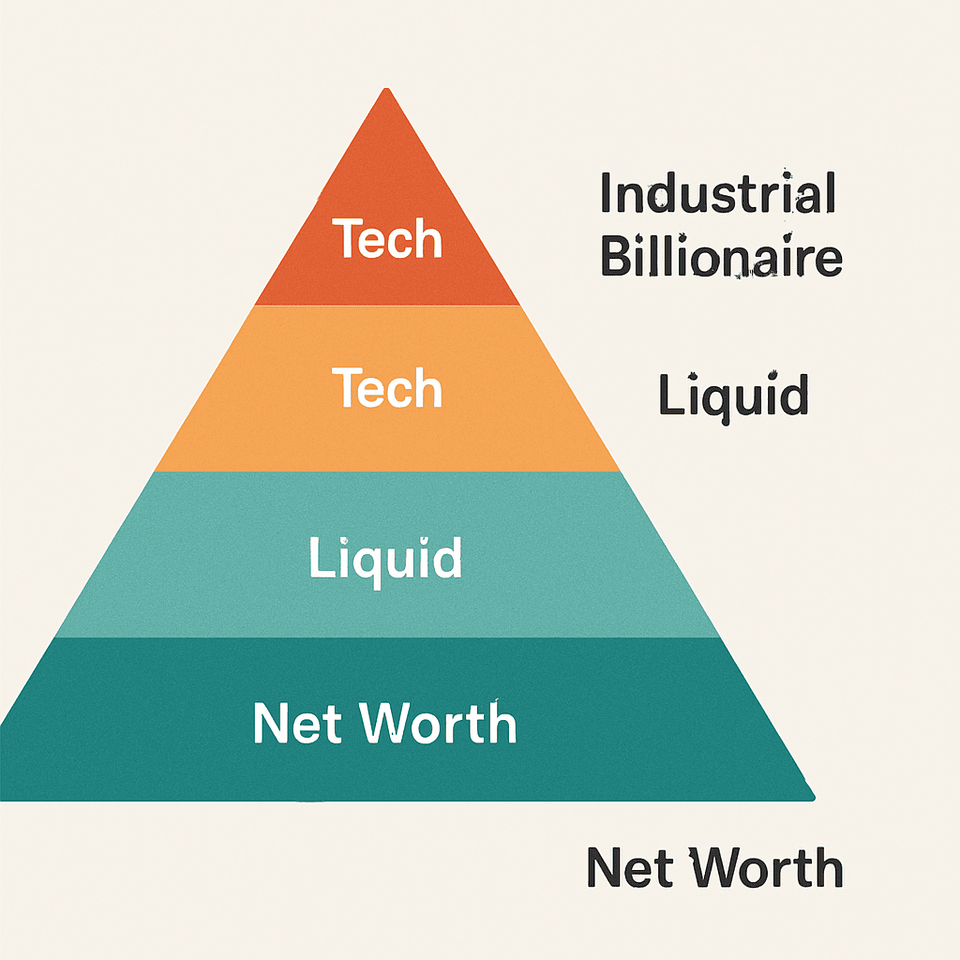
Till now, we have discussed the basic concepts in finance. Suppose you have not seen those posts. You can check them out here. In this post, we will discuss the different ranks of billionaires.
All billionaires are not made equal.
Networth Billionaire
This is the most straightforward metric. In this, all your assets are included, such as Equity, Bonds, Real Estate, Cash, and Precious Metals (gold and silver). So what is the catch here? Here, all the assets are included, both liquid and illiquid.
Net worth billionaires are individuals whose total assets minus liabilities exceed ₹8,300 crore (or $1 billion). Their wealth may be spread across businesses, real estate, stocks, private equity, and other holdings—not necessarily liquid or spendable. Here’s a breakdown of their pros and cons:
Some Pros of being a Networth Billionaire:
- Economic Impact: They often own or control large companies that create jobs, drive innovation, and contribute to GDP.
- Philanthropy: Many donate substantial sums to causes like education, healthcare, and climate change (e.g., Bill Gates, MacKenzie Scott).
- Long-Term Vision: Their wealth allows them to invest in moonshot ideas—space tech, AI, clean energy—that others can’t afford to fund.
- Global Influence: They can shape industries, markets, and even policy through strategic investments and lobbying.
- Stability: Their diversified holdings often make them more resilient to market shocks, which can stabilize sectors they’re involved in.
Some cons of being a Networth Billionaire:
- Wealth Inequality: Their existence highlights extreme disparities—often owning more than the wealth of millions of people combined.
- Limited Liquidity: Much of their wealth is tied up in illiquid assets (e.g., company shares), making it hard to access or redistribute.
- Market Power: Their control over industries can stifle competition and lead to monopolistic behavior.
- Political Influence: Their lobbying power can skew policy in favor of the ultra-wealthy, undermining democratic processes.
- Tax Optimization: They often use legal loopholes to minimize taxes, which can reduce public revenue for essential services.
Liquid Billionaire
These people hold significant wealth in cash or easily tradable assets (stocks, bonds). Offers high flexibility but lower returns.
Liquid billionaires are individuals whose wealth is readily accessible—held in cash, stocks, bonds, or other assets that can be quickly converted to money without significant loss. Unlike net worth billionaires whose wealth may be tied up in businesses or real estate, liquid billionaires have high financial agility. Here’s a breakdown of their pros and cons:
Some Pros of being a Liquid Billionaire:
- Market Influence: Their trades and investments can move markets, fund startups, or stabilize sectors.
- Transparency: Liquid assets are easier to track and value compared to private holdings or complex ownership structures.
- Philanthropic Speed: They can donate or fund initiatives without waiting for asset sales or board approvals.
- Crisis Resilience: In economic downturns, they can act quickly.
Some cons of being a Liquid Billionaire:
- Short-Term Bias: Liquid wealth may encourage short-term trading or speculation over long-term value creation.
- Concentration Risk: If heavily invested in a single asset class (e.g., tech stocks), they’re vulnerable to sector crashes.
- Limited Job Creation: Unlike business owners, they may not directly create employment or infrastructure.
- Regulatory Scrutiny: Large liquid moves (e.g., dumping shares) can trigger investigations or public backlash.
Liquid billionaires often emerge from finance, tech, or crypto—where wealth can be scaled quickly and cashed out efficiently.
Tech Billionaire
Wealth concentrated in tech company equity—often volatile but high-growth. Examples: Mark Zuckerberg, Larry Page.
Tech billionaires—like Elon Musk, Mark Zuckerberg, Larry Page, and Satya Nadella—are among the most influential figures in the modern economy. Their wealth is typically built through ownership of high-growth technology companies, platforms, or intellectual property
Pros of being a Tech Billionaire:
- Innovation Drivers: They fund and lead breakthroughs in AI, space exploration, biotech, and clean energy. Their risk appetite accelerates progress.
- Massive Scale: Tech platforms reach billions of users, democratizing access to information, commerce, and communication.
- Philanthropy & Impact: Many invest in global health, education, and climate initiatives (e.g., Gates Foundation, Musk’s XPrize).
- Job Creation: Their companies often generate thousands of high-paying jobs and stimulate entire ecosystems of startups and suppliers.
- Long-Term Vision: Many embrace “moonshot” thinking—pursuing bold, long-term goals like interplanetary travel or universal basic income
Cons of being a Tech Billionaire:
- Market Dominance: Their platforms can monopolize industries, stifling competition and innovation (e.g., Meta in social media, Google in search).
- Privacy & Ethics: Data collection, surveillance, and algorithmic manipulation raise serious concerns about user autonomy and consent.
- Ideological Risks: Some promote techno-utopian or “longtermist” ideologies that may ignore present-day inequalities or ethical dilemmas.
- Political Influence: Their lobbying and media ownership can shape public discourse and policy in ways that favor their interests.
- Public Distrust: Despite admiration for their success, surveys show many people view tech billionaires as poor role models or overly powerful.
Luxury/Industrial Billionaire
Wealth is tied to consumer brands, manufacturing, or infrastructure. Examples: Bernard Arnault (LVMH), Gautam Adani.
Luxury and industrial billionaires—like Bernard Arnault (LVMH), François Pinault (Kering), and the Ambani family (Reliance Industries)—represent two distinct but often overlapping domains of wealth. They build empires through high-end consumer goods or large-scale infrastructure, manufacturing, and energy
Some Pros of being a Luxury/ Industrial Billionaire:
- Cultural Influence: Shape global trends in fashion, design, and aesthetics.
- Brand Legacy: Build enduring brands that span generations.
- High Margins: Luxury goods often yield strong profits and pricing power.
- Philanthropy & Arts: Frequently support museums, galleries, and cultural institutions.
Some of the Cons of being a Luxury/ Industrial Billionaire:
- Exclusivity: Products cater to elites, reinforcing social divides.
- Environmental Impact: Luxury production can be resource-intensive and wasteful.
- Labor Ethics: Some brands face criticism over supply chain practices.
- Volatility: Consumer sentiment and fashion cycles can shift rapidly.
Some Pros of being an Industrial Billionaire:
- Mass Employment: Their companies often employ thousands across regions.
- Economic Backbone: Drive national development through energy, transport, and manufacturing.
- Long-Term Assets: Infrastructure and industrial holdings offer stability and scale.
- Tech Integration: Increasingly adopt digital twins, automation, and AI to modernize operations.
Some Cons of being an Industrial Billionaire:
- Political Ties: Often entangled with government contracts and regulatory influence.
- Monopoly Risks: Can dominate essential services, limiting competition.
- Resistance to Change: Legacy systems may slow innovation or sustainability efforts.
- Environmental Footprint: Heavy industries contribute to pollution and climate change.
This is all for this post. Hope you got to learn something new from this post. Don’t forget to follow my Facebook and Instagram pages for regular updates. See you all in the next post. Till then, keep learning.