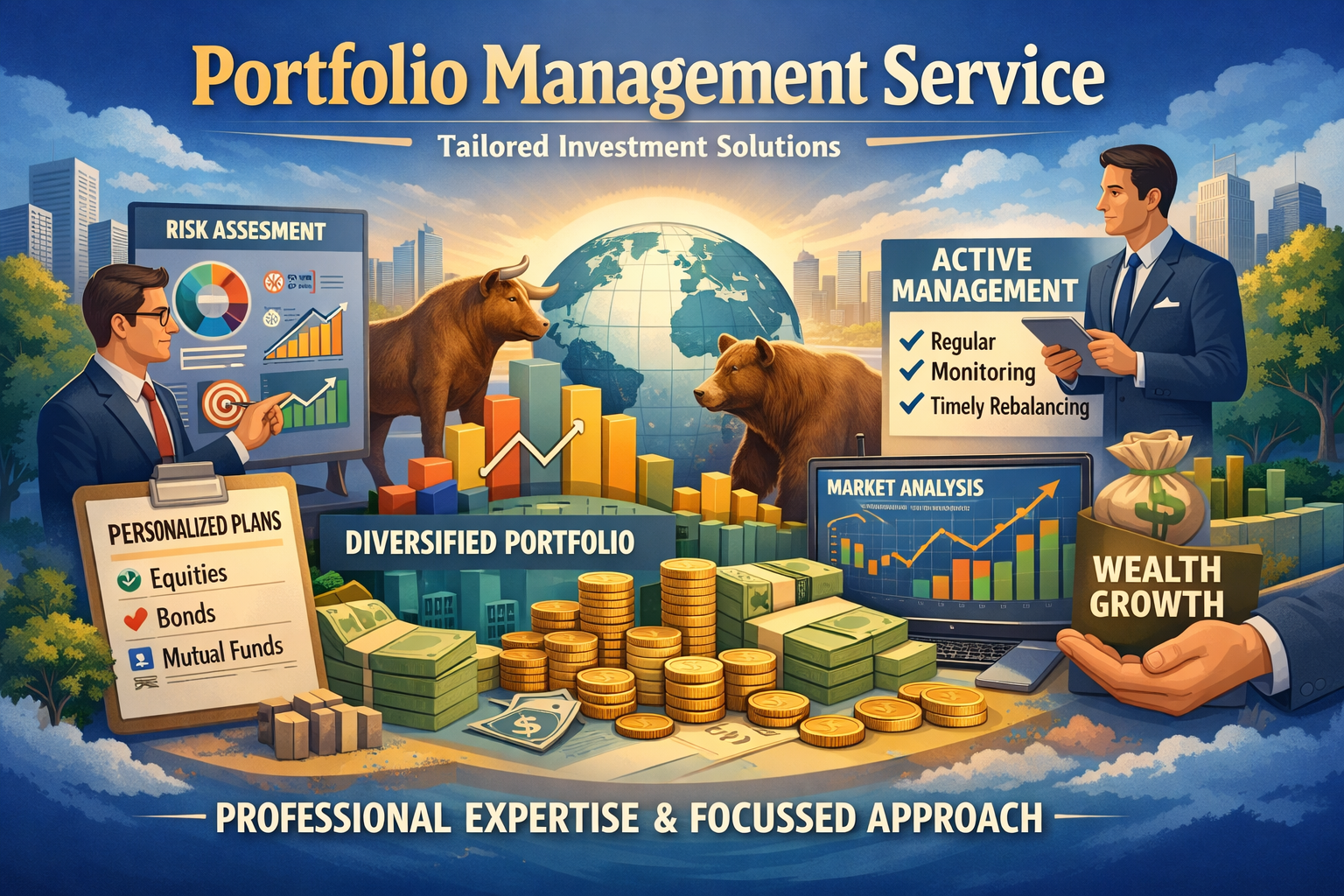
Till now, we have discussed the basic concepts in finance. Suppose you have not seen those posts. You can check them out here. In this post, we are going to discuss something that is not very often discussed in the world of finance. In this post, we are going to talk about Portfolio Management Service, popularly known as PMS.
What is a Portfolio Management Service (PMS)?
In the world of high-net-worth investing, one-size-fits-all solutions rarely deliver optimal results. Portfolio Management Services (PMS) were designed precisely for this reason — to offer wealthy investors a tailored, professionally managed investment experience that goes far beyond what mutual funds or robo-advisors can provide.
A PMS is a specialised investment vehicle wherein a SEBI-registered portfolio manager constructs and manages a customised portfolio of stocks, bonds, and other securities on behalf of an investor. Unlike mutual funds, where your money is pooled with thousands of other investors, in a PMS you directly own every security in your portfolio — giving you far greater transparency, tax efficiency, and control.
| 📌 Key Fact: As per SEBI regulations, the minimum investment threshold for a Portfolio Management Service in India is ₹50 Lakhs (₹50,00,000). This ensures PMS remains an exclusive, high-touch investment product designed for High Net Worth Individuals (HNIs) and Ultra HNIs. |
How Does PMS Work?
Understanding the mechanics of a PMS helps investors make informed decisions about whether it suits their financial goals.
Account Opening and KYC
The investor opens a dedicated demat and trading account. A detailed risk profile, investment objective, and financial goal assessment are completed before any money is deployed. The PMS provider signs a formal agreement with the investor outlining the investment mandate, fees, and reporting norms.
Portfolio Construction
The portfolio manager develops a customised investment strategy based on the investor’s objectives, risk tolerance, time horizon, and tax situation. This could range from a pure large-cap equity strategy to a multi-asset or thematic approach — entirely tailored to the investor.
Active Management
Unlike passive funds, PMS portfolios are actively managed. The fund manager continuously monitors macroeconomic conditions, sector developments, and company fundamentals to make real-time buy, sell, or hold decisions. The investor retains full transparency and receives regular reports.
Reporting and Communication
Investors receive detailed periodic reports — typically monthly — showing the holdings, transactions, performance attribution, and portfolio commentary. Direct access to the fund manager for queries and reviews is a hallmark of the PMS experience.
Types of Portfolio Management Services
Discretionary PMS
The most common type. The portfolio manager has full authority to make investment decisions without seeking the investor’s approval for each transaction. This model is best suited for investors who trust the manager’s expertise and prefer a hands-off approach.
Non-Discretionary PMS
Here, the portfolio manager recommends trades but executes them only after obtaining explicit approval from the investor. This is ideal for investors who want professional guidance but wish to retain decision-making authority over their portfolio.
Advisory PMS
The portfolio manager provides investment advice and recommendations, but the investor independently executes all trades through their own broker. The manager charges an advisory fee but has no execution responsibility.
PMS vs Mutual Funds vs Direct Equity
The table below highlights the key differences between Portfolio Management Services and other popular investment avenues in India:
| Feature | PMS | Mutual Fund | Direct Equity |
| Min Investment | ₹50 Lakhs | ₹500 | Any amount |
| Portfolio Type | Customised | Pooled | Self-managed |
| Transparency | Full (stock-level) | Limited (NAV) | Full |
| Direct Ownership | Yes | No | Yes |
| Tax Efficiency | High | Moderate | High |
| Manager Access | Direct | None | None |
| Regulation | SEBI | SEBI | Self |
Key Benefits of Investing in PMS
Customisation and Personalisation
Every portfolio is built around the individual investor’s specific goals, risk appetite, liquidity needs, and tax situation. You are not buying a pre-packaged product — you are co-designing a bespoke investment solution.
Direct Ownership of Securities
Unlike mutual funds, where you own units of a pooled fund, in PMS, you directly own every share or bond in your portfolio. This has significant implications for tax planning — you can harvest tax losses, time capital gains realisation, and manage your tax liability with precision.
Concentrated, High-Conviction Portfolios
Most PMS products run concentrated portfolios of 15–30 stocks, reflecting the manager’s highest conviction ideas. This focused approach has historically generated superior alpha compared to highly diversified funds that end up mirroring the index.
Transparency
Full visibility into every holding, every transaction, and the rationale behind portfolio decisions. Investors always know exactly what they own and why.
Access to Expert Fund Managers
PMS investors benefit from direct access to experienced fund managers — people who have navigated multiple market cycles and built strong track records. Quarterly calls, portfolio reviews, and personalised updates are standard features.
| 💡 Did You Know? The Indian PMS industry manages over ₹25 lakh crore in assets as of 2024, reflecting the growing appetite among HNIs for customised, professionally managed investment solutions. The number of SEBI-registered PMS providers has crossed 400. |
Risks and Considerations
As with any investment product, PMS comes with risks that investors must understand before committing capital.
Market Risk
Since most PMS portfolios are heavily equity-oriented, they are exposed to market volatility. A sharp market downturn can erode portfolio value significantly in the short term.
Concentration Risk
The high-conviction, concentrated nature of PMS portfolios means that poor performance in even a few stocks can materially impact returns. Diversification is intentionally limited.
Manager Risk
Performance is heavily dependent on the skill, judgement, and discipline of the portfolio manager. Inconsistent decision-making or key-man dependency can negatively impact outcomes.
Liquidity Risk
PMS portfolios may hold some mid-cap or small-cap positions that are less liquid. Exiting the PMS may require time to liquidate positions without impacting market prices.
High Minimum Investment
The ₹50 lakh SEBI minimum threshold means PMS is inaccessible to most retail investors. Even within the HNI category, this represents a significant commitment to a single manager.
Fee Structures in PMS
Understanding how PMS providers charge is critical to evaluating net returns. There are three primary fee models:
Fixed Fee Model
A fixed annual management fee (typically 1%–2.5% of AUM) regardless of performance. Predictable costs, but the manager earns the same whether they outperform or underperform.
Performance Fee Model
No fixed fee; instead, the manager charges a percentage of profits above a hurdle rate (typically 10%–15% of gains above the benchmark). Aligns manager incentives with investor outcomes.
Hybrid Fee Model
A combination of a lower fixed fee (0.5%–1%) plus a performance fee. The most common structure among premium PMS providers is balancing fee predictability with performance alignment.
| ⚠️ Investor Tip Always evaluate PMS returns on a NET-of-fees basis. A fund generating 20% gross returns with 2.5% fixed fees and 20% profit share on gains above 10% may net you significantly less than the headline number suggests. Ask for XIRR (Extended Internal Rate of Return) calculations on post-fee, post-tax returns. |
Who should invest in PMS?
PMS is not for every investor. It is ideally suited for:
- High Net Worth Individuals (HNIs) with investable surplus of ₹50 lakhs or more in equities
- Investors with a long-term horizon of at least 3–5 years who can ride out market volatility
- Those seeking customisation that mutual funds cannot provide, particularly around tax efficiency
- Business owners, promoters, or professionals with complex tax situations who benefit from direct ownership
- Investors who want meaningful access to their fund manager and detailed transparency into portfolio decisions
- Those comfortable with higher concentration and the associated risk-reward tradeoff
PMS may NOT be suitable for:
- Investors requiring high liquidity or who may need to exit within 1–2 years
- Those with low risk tolerance unwilling to accept short-term portfolio volatility
- Retail investors who are below the ₹50 lakh minimum threshold
- Investors seeking guaranteed returns or capital protection
How to Choose the Right PMS Provider
With over 400 SEBI-registered PMS managers in India, selecting the right one requires careful due diligence. Here is a structured framework:
Evaluate Track Record
Request audited, SEBI-compliant performance data for a minimum of 5 years across multiple market cycles. Look for consistency, not just peak-year returns. Compare performance against relevant benchmarks on a net-of-fees basis.
Understand the investment Philosophy
Every PMS has a distinct investment philosophy — value, growth, quality, GARP (Growth at a Reasonable Price), or quantitative. Ensure the philosophy resonates with your own investment beliefs and complements your existing portfolio.
Assess the Team
Research the fund manager’s background, years of experience, and whether the process is individual-dependent or institutionalised. A robust investment process that survives key-person departures is a critical quality indicator.
Fee Transparency
Insist on complete transparency around all fees — management fees, exit loads, brokerage charges, and custodial costs. Model out the effective fee drag on your expected returns before committing.
Risk Management Framework
Understand the portfolio’s typical concentration, sector limits, and how drawdowns are managed. A PMS that generated 35% returns but experienced a 60% drawdown in 2020 may not suit all investors.
SEBI Regulation and Investor Protection
PMS in India is regulated by the Securities and Exchange Board of India (SEBI) under the SEBI (Portfolio Managers) Regulations, 2020. Key investor protections include:
- Mandatory registration and net worth requirements for all PMS providers
- Minimum investment threshold of ₹50 lakhs to protect retail investors from high-risk products
- Mandatory disclosure of standardised performance data and fee structures
- Prohibition on offering guaranteed returns
- Requirement to maintain a separate demat and trading account for each client
- Annual audits and regular SEBI reporting obligations
Always verify your PMS provider’s SEBI registration on the official SEBI website before investing. A registered manager can be found at www.sebi.gov.in under the Intermediaries section.
Conclusion
Portfolio Management Services represent the gold standard of personalised wealth management for India’s high-net-worth community. When chosen wisely, a PMS can deliver superior risk-adjusted returns, meaningful tax efficiency, and a level of customisation that no pooled vehicle can match.
However, PMS is not a silver bullet. Success depends on selecting the right manager, aligning the investment philosophy with your goals, understanding the fee structure deeply, and committing to a long enough horizon to let the strategy play out through market cycles.
For investors who meet the financial threshold and are willing to engage meaningfully with their portfolio manager, PMS can be a genuinely transformative wealth-building tool.
Comparison between our PMS and other PMS out there
I have been using a PMS service. If you are interested in exploring these PMS services, you can use this link to fill out the form so the team can contact you. The distinguishing feature of this PMS compared to other PMS is that you can start with a smaller amount than the minimum amount mentioned above.
This is all for this post. Hope you got to learn something new. Don’t forget to follow my Facebook and Instagram pages for regular updates. See you all in the next post. Till then, keep learning.