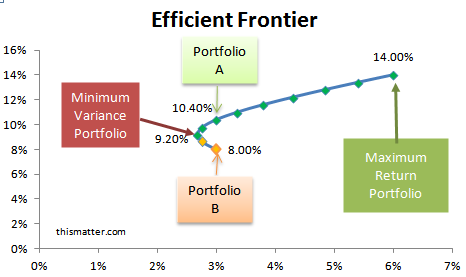
Till now, we have discussed the basic concepts in finance. Suppose you have not seen those posts. You can check them out here. In this post, we will discuss a technical topic used in portfolio construction, the efficient frontier.
So what is an efficient frontier?
The efficient frontier is a concept from modern portfolio theory that represents the set of optimal portfolios offering the highest expected return for a given level of risk, or the lowest risk for a given level of return. It helps investors balance risk and reward when constructing portfolios.
In the world of investing, one of the most important challenges is balancing risk and return. Investors want to maximise returns, but every investment carries uncertainty. The efficient frontier, introduced by Harry Markowitz in 1952, provides a mathematical framework to identify the best possible portfolios under this trade-off.
Technical Details
- The efficient frontier is a curve on a risk-return graph:
- X-axis: Risk (measured by standard deviation of returns).
- Y-axis: Expected return.
- Portfolios lying on the frontier are considered optimal because:
- No other portfolio offers a higher return for the same risk.
- No other portfolio offers lower risk for the same return.
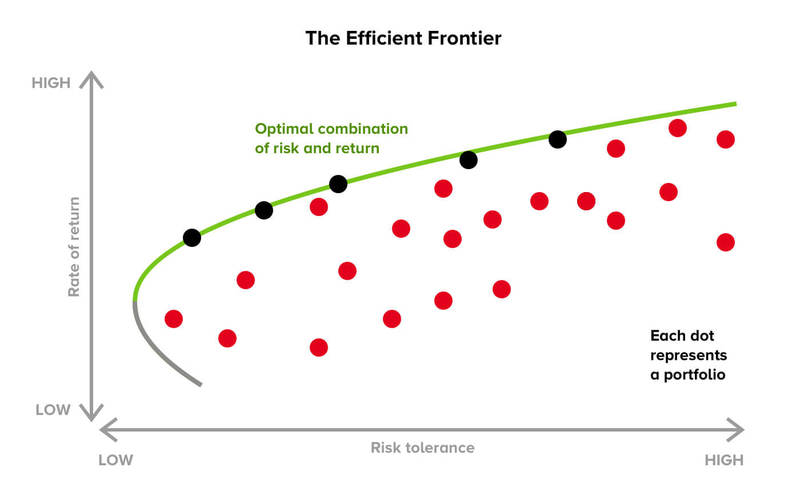
Portfolios below the frontier are suboptimal (inefficient), while those above are unattainable given current assets and correlations.
Key Components of efficient frontier
- Expected Return: The weighted average of asset returns.
- Risk (Variance/Standard Deviation): Measures volatility of portfolio returns.
- Covariance/Correlation: How assets move relative to each other; diversification reduces risk when correlations are low.
How the efficient frontier works in Portfolio Construction
- Step 1: Estimate expected returns, risks, and correlations of assets.
- Step 2: Generate combinations of assets with different weights.
- Step 3: Plot risk vs. return for each portfolio.
- Step 4: Identify the “efficient frontier” — the upper boundary of feasible portfolios.
Investors then choose a portfolio along the frontier based on their risk tolerance:
- Risk-averse investors → portfolios on the lower-left (low risk, moderate return).
- Aggressive investors → portfolios on the upper-right (higher risk, higher return).
Practical Example
Suppose you combine stocks and bonds:
- 100% bonds → low risk, low return.
- 100% stocks → high risk, high return.
- A mix → diversification reduces risk while maintaining reasonable returns.
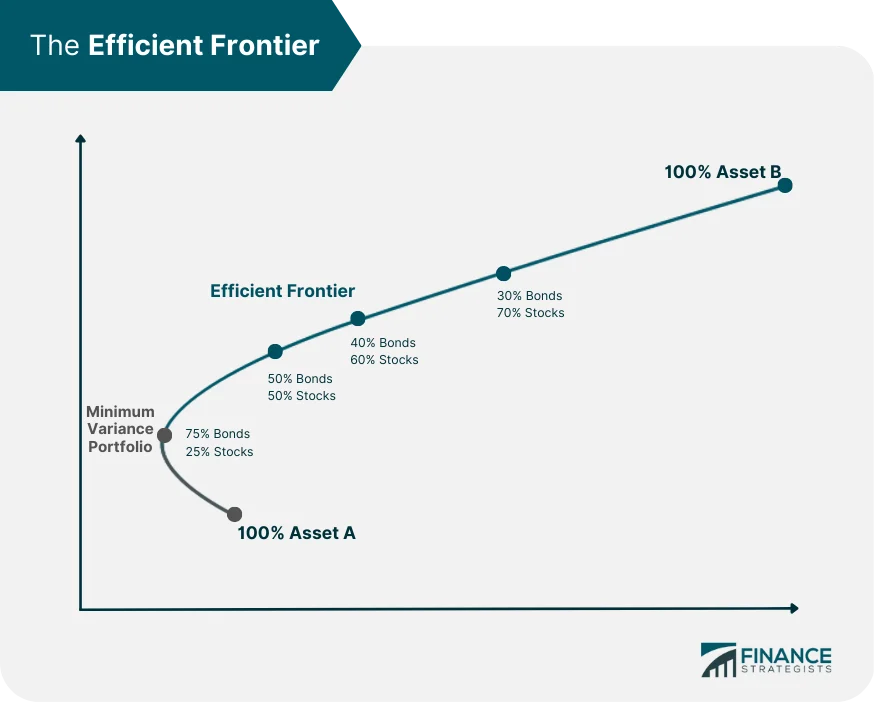
The efficient frontier shows the best mix of stocks and bonds for each risk level.
Extensions
- Capital Market Line (CML): When a risk-free asset is available, the efficient frontier becomes a straight line tangent to the curve.
- Sharpe Ratio Optimisation: Investors often select the portfolio on the frontier with the highest risk-adjusted return.
- Real-World Use: Mutual funds, robo-advisors, and institutional investors use efficient frontier analysis to design portfolios.
Conclusion
The efficient frontier is a cornerstone of modern portfolio theory, guiding investors to construct portfolios that maximize returns for a given risk. By understanding and applying this concept, investors can make more informed decisions, balancing ambition with caution in pursuit of long-term financial goals.
Efficient Frontier can be extended to more than two assets, incorporating rare metals, cryptos, etc.
This is all for this post, hope you got to learn something new from this post. Don’t forget to follow my Facebook and Instagram pages for regular updates. See you all in the next post. Till then, keep learning.